Why Are Your Cabinet Doors Crooked? Common Causes and Fixes
Uneven cabinet doors are often caused by loose or misadjusted hinges, but the cabinet box, door shape, hinge wear, and installation can also affect the gaps.
Quick answer
Crooked cabinet doors are usually a symptom, not a diagnosis. A door may be sagging because mounting screws are loose, the hinge needs adjustment, the hinge cup is pulling out, the cabinet box is out of square, or the door itself has warped.
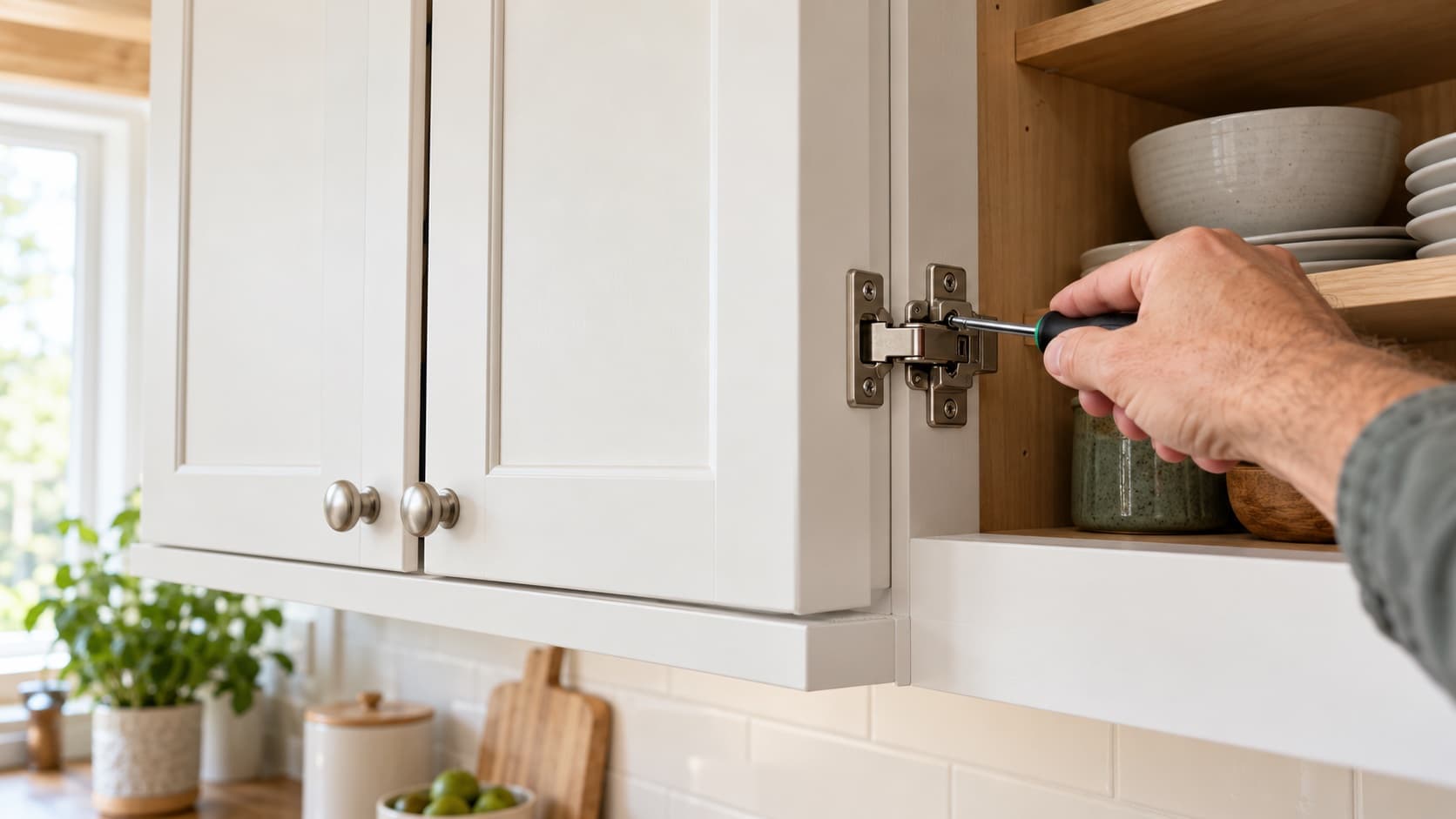
Many modern concealed hinges offer three adjustments: side-to-side, height, and depth. Adjusting the wrong screw can trade one problem for another, so identify the pattern before turning anything.
Read the gap before touching the hinge
| What you see | Likely place to check |
|---|---|
| Door is uniformly too high or too low | Height adjustment or mounting-plate position |
| Gap is narrow at the top and wide at the bottom | Side adjustment across the upper and lower hinges |
| One corner sits farther out than the others | Depth adjustment, hinge seating, or cabinet twist |
| Door rubs the neighboring door | Side adjustment, loose hinge, or door width/gap issue |
| Door will not stay closed | Depth, soft-close mechanism, hinge wear, obstruction, or cabinet alignment |
| Door was aligned but keeps sagging again | Loose fasteners, damaged screw holes, failing hinge, or heavy/warped door |
Look at the entire run of doors from several feet away. Consistent reveal lines matter more than making one edge match a countertop or floor that may not be level.
Cause 1: loose hinge or mounting-plate screws
Open the door and support its weight. Check the screws holding the hinge cup to the door and the mounting plate to the cabinet. A loose plate can let the door drop even when the adjustment settings have not changed.
Tighten only until the hardware is secure. Over-tightening can strip particleboard or MDF. If a screw spins without tightening, the hole needs repair or different hardware rather than more force.
Cause 2: the hinge needs three-way adjustment
Side adjustment
Moves the door left or right and changes the reveal between neighboring doors. Correct a diagonal gap by making small, coordinated changes at the top and bottom hinges.
Height adjustment
Moves the whole door up or down. Depending on the hinge, this may use a cam on the mounting plate or require loosening the plate screws, shifting the door, and retightening.
Depth adjustment
Moves the door closer to or farther from the cabinet box. Use it to make the door face sit evenly and to maintain enough clearance for smooth closing.
The screw locations and adjustment ranges vary by hinge. Use the manufacturer’s diagram for the exact model instead of assuming every concealed hinge works the same way.
Cause 3: the cabinet box is not level or square
If several doors are crooked in the same direction, the issue may start with the cabinet rather than the hinges. Check whether the cabinet is level, securely fastened, and square. On a newly assembled cabinet, an out-of-square box can make every door gap look wrong.
Hinge adjustment can improve the appearance within its available range, but it cannot fully correct a twisted cabinet, loose wall attachment, or poorly supported base cabinet.
Cause 4: hinge wear or damage
- A bent hinge arm can change the door angle.
- A worn pivot can create play that adjustment cannot remove.
- A failed soft-close mechanism may resist or pull unevenly.
- A loose hinge cup can move inside damaged door material.
- Mismatched replacement hinges may have different overlays or mounting geometry.
When replacing a hinge, match the opening angle, overlay type, cup size and pattern, mounting plate, cabinet construction, and closing feature. Similar-looking hinges are not necessarily interchangeable.
Cause 5: the door is warped, swollen, or overloaded
Moisture, heat, material movement, or a heavy accessory mounted to the door can change its shape or increase stress on the hinges. Lay a straightedge across the door face or compare the corners against a known-flat reference. A warped door may never produce even gaps through hinge adjustment alone.
Also check for shelf liners, pull-out accessories, dishes, or interior parts that prevent the door from closing fully. Sometimes the apparent hinge problem is simply an obstruction inside the cabinet.
A controlled way to adjust cabinet doors
- Empty fragile items near the work area and support the door.
- Tighten loose attachment screws before changing alignment screws.
- Mark the starting screw positions with a pencil or take a close photo.
- Make a small change—about a quarter turn—then close the door and inspect the full gap.
- Work from height to side alignment and finish with depth.
- Adjust both hinges as a system rather than forcing one hinge to do all the work.
- Open and close the door several times and confirm that it does not rub or bind.
“Small changes are easier to reverse. Turning several screws at once makes it difficult to know which adjustment helped.”
When adjustment is not enough
Stop adjusting if the screw holes are stripped, the hinge is bent, the door is cracked around the cup, the cabinet is loose, or the door remains warped. Those conditions require repair, replacement, or cabinet-level correction.
For a faster assessment, send photos of the closed door gaps, each hinge with the door open, the full cabinet run, and any damaged screw holes. Include whether the problem appeared suddenly or has gradually returned.
Frequently asked questions
Which screw fixes a crooked cabinet door?
It depends on the hinge and the direction of the misalignment. Modern concealed hinges commonly separate side, height, and depth adjustments. Check the hinge manufacturer’s diagram before turning a screw.
Why does the door become crooked again?
Repeated sagging usually points to a loose mounting plate, stripped screw hole, worn hinge, heavy or warped door, or cabinet movement—not simply an adjustment that was missed.
Can I adjust soft-close hinges?
Many soft-close concealed hinges are adjustable, but the damping control and alignment screws serve different purposes. Use the instructions for the exact hinge model.
Should all cabinet gaps be exactly equal?
The goal is a consistent, functional reveal across the cabinet run. Real walls, floors, and cabinet boxes are not always perfect, so the best result balances appearance with smooth operation.