How to Create a Gallery Wall That Looks Balanced
A gallery wall does not need matching frames or perfect symmetry. It needs a clear overall shape, consistent spacing, balanced visual weight, and a connection to the furniture below it.
1. Measure the wall and furniture
Measure the wall and note nearby doors, windows, switches, vents, lighting, and molding.
When the art hangs above a sofa, bed, or console:
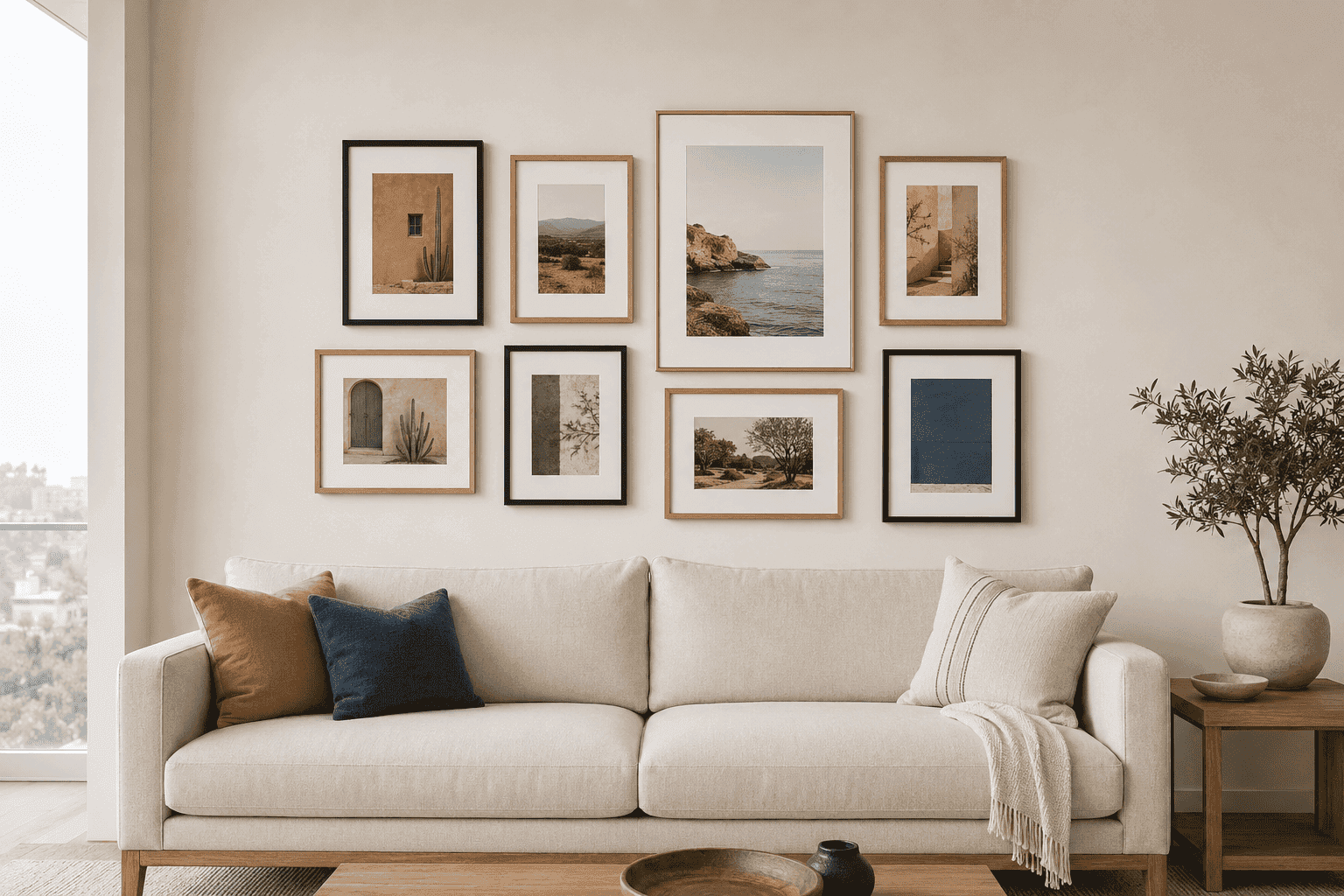
- Center the arrangement on the furniture or its visual zone.
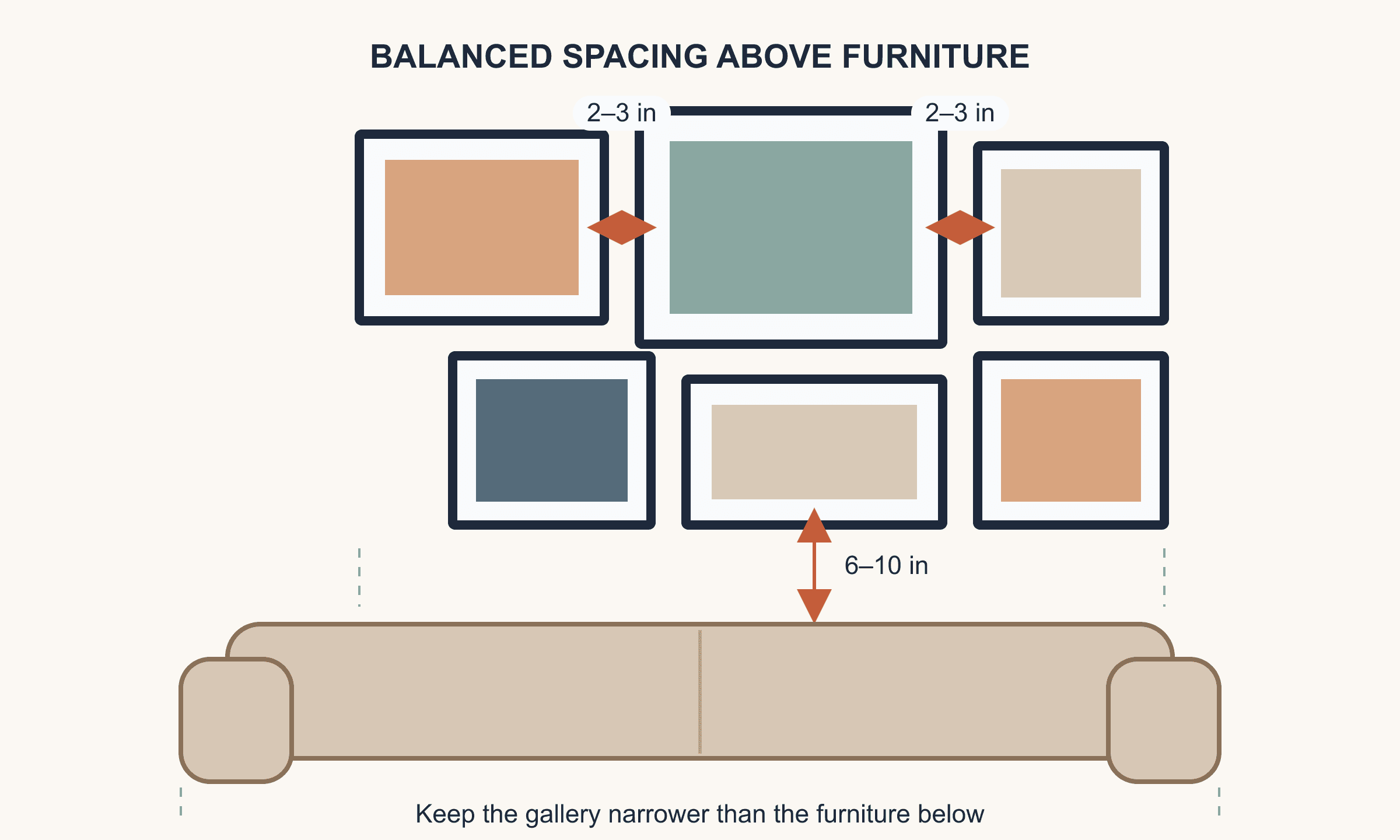
- Keep the full gallery slightly narrower than the furniture below.
- Start with about 6-10 inches between the furniture and the lowest frame, then adjust for the room and frame sizes.
2. Choose one anchor piece
Pick the frame with the most visual weight, usually the largest, darkest, or most colorful piece. Place it near the center and build outward. In an organic layout, the anchor can sit slightly off-center.
3. Treat the group as one large shape
Imagine a rectangle around the arrangement. The outside edges can step in and out, but no frame should feel isolated. A grid needs aligned edges; a relaxed cluster can be irregular while keeping a controlled overall width and height.
4. Keep the gaps consistent
Use 2-3 inches between frame edges as a starting point. Small frames can sit closer; very large or deep frames may need more space. Measure between the frames, not between hooks.
5. Balance visual weight
Size is not the only factor. A black frame, bright photograph, thick mat, or shadow box can feel heavier than a larger pale frame.
Spread the strongest pieces across the composition. If one side has a large dark frame, balance it with a few lighter pieces on the opposite side.
Repeat at least one element:
- frame finish
- mat color
- artwork style
- frame width
- spacing
Two or three frame finishes are usually enough.
Three layouts that are easy to balance
- Grid: Best when the frames have similar dimensions. Keep rows, columns, and gaps equal.
- Centered cluster: Build smaller pieces around one anchor. This works well above a sofa or console.
- Horizontal line: Align the frames along a shared lower edge or center line. This is useful in hallways and above long furniture.
Test the layout before making holes
Arrange the frames on the floor and photograph the layout from above. For better accuracy, trace each frame onto kraft paper, mark its hanging point, and tape the templates to the wall.
Then step across the room and check:
- Is the group centered on the furniture?
- Does it feel too high or too small?
- Are the gaps consistent?
- Is one side visually heavier?
Choose hardware for the wall and frame
The fastener depends on the frame weight, hanging hardware, wall material, and location. Removable strips may work for compatible lightweight frames on clean, smooth surfaces within the manufacturer's limits. Heavy frames, mirrors, shadow boxes, and pieces above beds or seating generally need an appropriate mechanical fastener.
Plaster, masonry, tile, and metal-stud walls require wall-specific hardware. Professional installation is useful when the artwork is heavy, valuable, or difficult to reach.
Common mistakes
- Hanging the gallery too high and disconnecting it from the furniture.
- Using random gaps between frames.
- Making the arrangement too small for a large sofa or wall.
- Placing all dark or colorful pieces on one side.
- Drilling before confirming the complete layout.
Need help installing a gallery wall in Los Angeles?
Send DrillWorks a wall photo, frame dimensions and weights, and your preferred layout. We can plan the spacing, align the arrangement, and choose an appropriate mounting method.
Frequently Asked Questions
How far apart should gallery wall frames be?
Start with a consistent 2-3-inch gap measured between frame edges. Small frames may look better slightly closer together; larger or deeper frames may need more room.
Should all gallery wall frames match?
No. Mixed frames look intentional when at least one feature repeats, such as the mat color, frame finish, artwork style, or spacing.
Should a gallery wall be centered on the wall or the sofa?
Above furniture, center it on the sofa, console, bed, or the visual zone it belongs to, not automatically on the entire room.
Can removable strips be used for a gallery wall?
Yes, but only for compatible lightweight frames and smooth surfaces, within the manufacturer's stated weight and surface limits.