How to Hide TV Wires: In-Wall & No-Cut Options
Choose the right TV wire concealment method for your wall, outlet location, devices, and rental restrictions.
Quick answer
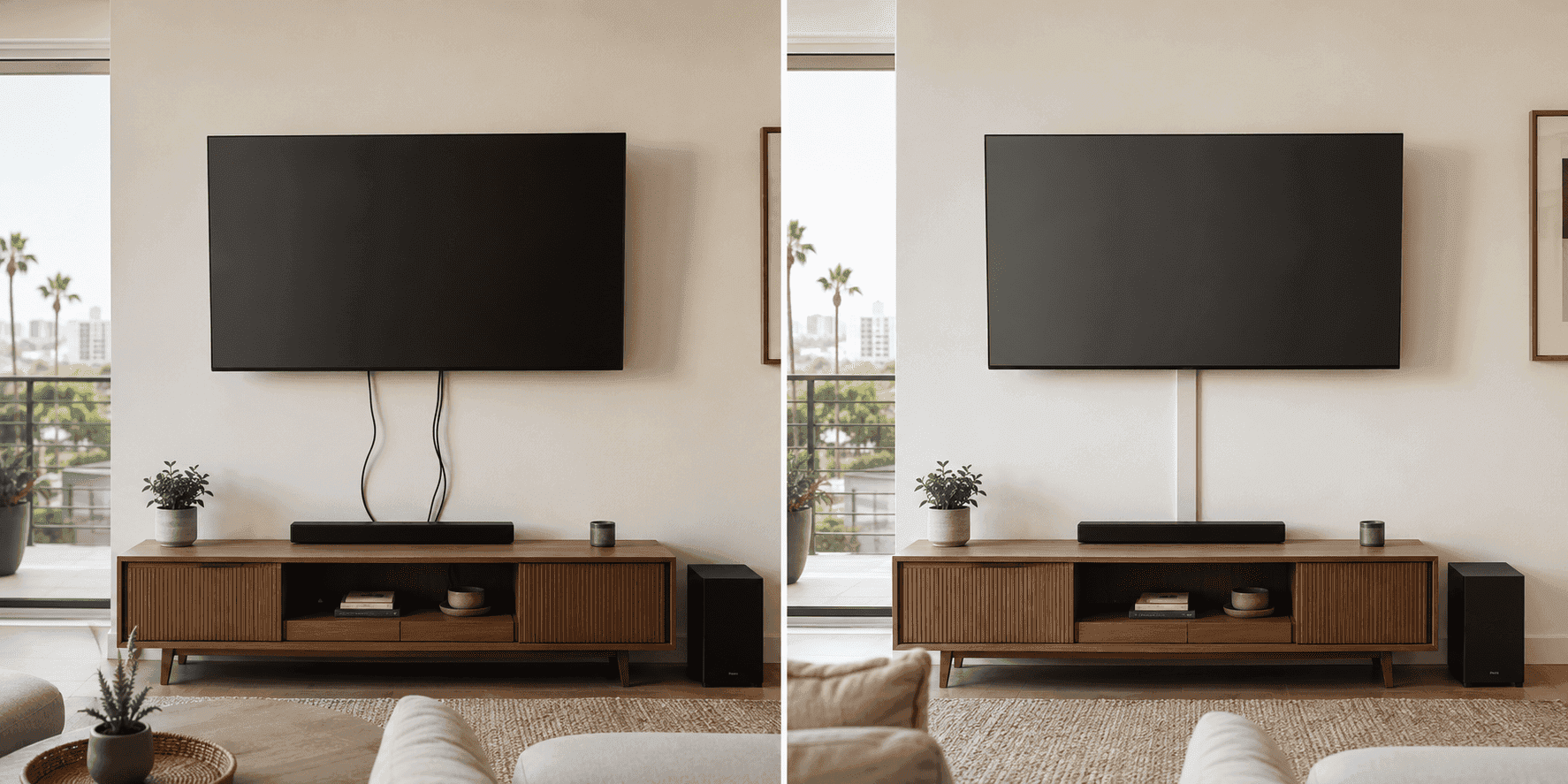
A wall-mounted TV looks finished only when the cables are planned too. The best way to hide TV wires depends on the wall, outlet location, devices, and whether you want a permanent or renter-friendly result.
- Best no-cut option: a paintable surface raceway.
- Best temporary option: a cable sleeve with most of the run hidden behind furniture.
- Cleanest signal-cable option: in-wall-rated HDMI, Ethernet, coax, or audio cables routed between brush plates.
- Cleanest power option: a listed in-wall power kit or a properly installed recessed receptacle.
Do not route a standard extension cord or detachable TV power cord loosely inside the wall. Power and low-voltage cables require separate, suitable solutions.
Compare the main TV wire concealment options
| Method | Wall opening | Finished look | Best for |
|---|---|---|---|
| Paintable raceway | None or small fastener holes | Clean, but visible | Renters, masonry, blocked wall cavities |
| Sleeve + furniture routing | None | Organized, not fully hidden | Temporary setups and TVs close to a console |
| In-wall low-voltage routing | Usually two plate openings | Nearly invisible | HDMI, Ethernet, coax, optical, speaker wire |
| Listed power kit or recessed outlet | Wall openings; electrical scope varies | Cleanest | Long-term installations and slim mounts |
1. Paintable surface raceway
A surface raceway is a slim channel mounted on top of the wall. It is practical when:
- the property is rented;
- the wall is concrete, brick, or difficult to open;
- blocking or utilities prevent a clear in-wall route; or
- cables may be changed later.
Run it in one straight vertical line toward the console or outlet. Paintable models blend in after the setup has been tested.
No-cut does not always mean no damage. Strong adhesive can lift weak paint or drywall paper. If the lease allows it, a few small screw holes may be easier to patch predictably at move-out.
2. Cable sleeve or furniture-based routing
A sleeve combines several cords into one bundle but does not make them disappear. It works best when the TV is close to a console and only a short section is visible.
Keep devices inside the console, secure loose cords behind it, and leave enough slack to remove the TV without straining the ports. This is fast, but less polished than a raceway or in-wall installation.
3. In-wall concealment for HDMI and data cables
Compatible low-voltage cables can be routed between a plate behind the TV and another near the equipment.
- HDMI
- Ethernet
- Coaxial cable
- Optical audio
- Speaker wire
- Other compatible audio/video connections
Use cables marked for the intended in-wall application. Horizontal blocking, insulation, plumbing, wiring, masonry, and fire-rated construction can block a simple vertical drop.
Plan for future devices before closing the route. An extra rated cable, or a pull string where appropriate, can make later changes easier.
4. In-wall power kit or recessed outlet
Signal cables are only half of the job: the TV still needs power.
A listed in-wall TV power kit brings power to a recessed connection behind the TV. A recessed receptacle keeps the plug from pressing against a slim mount.
Permanent electrical work may require a qualified electrician. A normal extension cord, surge-strip cord, or detachable TV cord is not a substitute for an approved in-wall power method.
What to check before opening the wall
Confirm these details before choosing an in-wall route:
- TV and mount model;
- wall material and thickness;
- nearest usable outlet;
- stud direction and possible horizontal blocking;
- all connected devices and cable types;
- soundbar position;
- fireplace, plumbing, HVAC, or electrical obstacles;
- rental or building restrictions.
Test the TV, soundbar, network connection, and every HDMI input before closing plates or raceways.
Can TV wires be hidden above a fireplace?
Sometimes, but fireplace walls need extra assessment. Heat, masonry, metal framing, vents, fire blocking, mantels, and limited cable paths can make a normal wall drop unsuitable.
When the internal path is uncertain, a surface raceway along an edge, corner, or adjacent cabinet may be more practical.
Common mistakes
- Hiding HDMI but forgetting the power plan.
- Running an ordinary power or extension cord inside the wall.
- Buying cables that are too short for the full route and service slack.
- Closing the raceway before testing every device.
- Assuming every drywall cavity is open from top to bottom.
- Mixing power and signal cables without using a system designed for that layout.
- Choosing a box without enough clearance for the mount or plugs.
Frequently asked questions
Can I hide TV wires without cutting drywall?
Yes. A paintable raceway is the cleanest common choice. A sleeve, clips, or furniture routing can also reduce the visible run.
Can HDMI cables go inside a wall?
Yes, when the cable is marked for the intended in-wall use. Do not assume every HDMI cable is suitable.
Can I run the TV power cord through the wall?
Do not use a standard detachable TV cord or extension cord as concealed in-wall wiring. Use a listed in-wall TV power system or a properly installed receptacle.
Is a recessed outlet necessary?
Not always. It is most useful with slim mounts, large plugs, or accessories behind the TV. A listed power kit may be another option.
What is the best option for renters?
A paintable raceway usually offers the best balance of appearance and reversibility. Check the lease before using adhesive or fasteners.
Need help hiding TV wires in Los Angeles?
DrillWorks provides TV mounting and cable-management options for Los Angeles homes and apartments, including raceways, brush plates, compatible in-wall routing, recessed TV boxes, soundbar mounting, and device setup.
Send photos of the full TV wall, the nearest outlet, the mount, and every connected device. We will explain the practical options before scheduling.