Can You Mount a TV on Metal Studs? What Homeowners Should Know
Learn when a metal-stud wall can support a TV, which mount styles create more leverage, and when reinforcement may be needed.
Quick answer
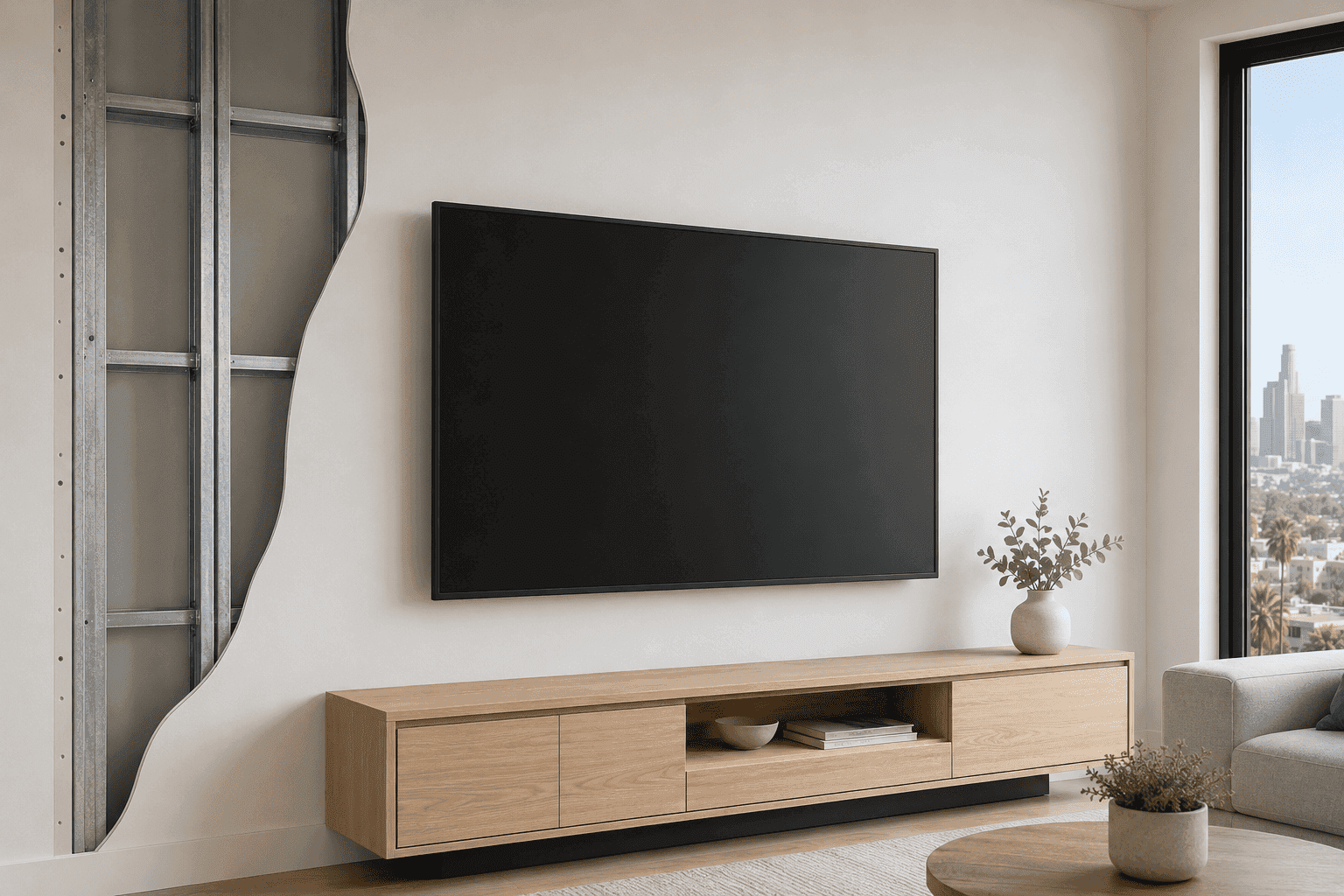
Yes, many TVs can be mounted on metal-stud walls, but the installation method is different from mounting into wood. The TV, mount, fasteners, drywall, stud gauge, attachment pattern, and wall condition all work as one system.
- Fixed mounts are usually the simplest option because the TV stays close to the wall.
- Tilt mounts often work when the mount and steel-stud hardware are compatible.
- Full-motion mounts need more caution because extending the arm increases pulling and twisting force.
- Standard wood lag bolts are not a universal solution for thin steel framing.
- TV size alone does not determine safety. Weight, mount geometry, stud spacing, drywall, and installation method matter more.
Some TV-mount manufacturers offer specific steel-stud kits or require a metal-stud accessory. Follow the instructions for the exact mount rather than relying on a generic anchor capacity.
Metal studs vs. wood studs
Wood studs provide a thick section of solid lumber for a lag screw. Metal studs are hollow and are commonly formed from much thinner sheet steel.
That difference changes the connection:
- a wood lag screw does not engage thin steel like it engages lumber;
- the load may need to be spread across multiple attachment points or studs;
- the drywall condition becomes part of the assessment; and
- the mount plate must align with the approved hardware pattern.
Finding a vertical line with a stud finder is only the first step. It does not reveal the stud gauge, wall thickness, hidden backing, utilities, or whether the selected mount is approved for that wall.
Which mount type works best?
| Mount type | Force on the wall | Typical metal-stud approach | Main concern |
|---|---|---|---|
| Fixed | Lowest | Compatible steel-stud kit or approved multi-point attachment | Mount plate and stud alignment |
| Tilt | Low to moderate | Wall-specific hardware approved by the mount manufacturer | Added offset from the wall |
| Full-motion | Highest when extended | Often a wider plate, multiple studs, or structural backing | Pulling, twisting, and repeated movement |
A full-motion mount can feel solid while retracted but apply much more leverage when extended. That does not make every articulating installation impossible; it means the wall and mount need to be approved for the real extended position, not judged only while the TV is flat against the wall.
What determines whether the installation is suitable?
There is no trustworthy universal rule such as "metal studs can hold any 65-inch TV." The assessment should include:
- combined weight of the TV and mount;
- fixed, tilt, or full-motion design;
- maximum distance the TV can extend;
- mount plate width and hole pattern;
- number, spacing, gauge, and condition of the studs;
- drywall thickness and condition;
- plywood backing or blocking, if present;
- fastener type, quantity, and approved wall assembly; and
- existing holes, patches, moisture, or other damage.
An anchor's advertised capacity is not the capacity of the finished installation. Product ratings depend on a specific material, thickness, load direction, edge distance, and installation procedure.
What hardware is used?
Depending on the wall and mount, the solution may include:
- a manufacturer-approved steel-stud mounting kit;
- heavy-duty toggle hardware suitable for the actual wall assembly;
- a wall plate designed to span multiple studs;
- fasteners specified for light-gauge steel framing; or
- plywood backing or wood blocking installed behind the finished wall.
Do not assume the hardware packaged for wood-stud installation is also approved for steel studs. Some mount manuals specifically require an additional steel-stud kit, while others do not permit drywall-only installation.
Can a TV be mounted without attaching to the studs?
Some rated hollow-wall systems can support substantial loads in specific wall assemblies, but that does not make every drywall-only TV installation appropriate.
The installer still has to evaluate the drywall thickness and condition, mount plate, number and spacing of attachment points, load direction, and leverage. The exact TV-mount instructions should take priority over a general weight claim on an anchor package.
For a large TV, damaged drywall, or an extending arm, connection to compatible framing or structural backing is usually the more conservative plan.
When reinforcement may be needed
Backing or another mounting approach may be appropriate when:
- the TV or mount is unusually heavy;
- the customer wants a long full-motion arm;
- the mount plate cannot reach enough suitable studs;
- the drywall is thin, soft, patched, or damaged;
- the stud gauge or wall construction is uncertain;
- the area has multiple old anchor holes; or
- the TV will be extended and repositioned frequently.
Possible solutions include a wider approved wall plate, plywood backing, wood blocking, opening and repairing a controlled section of drywall, or choosing a lower-profile mount.
How can you tell if the wall has metal studs?
Common clues include:
- a newer apartment, condominium, or commercial-style building;
- a magnet tracing vertical rows of drywall screws;
- narrow or inconsistent electronic stud-finder readings; or
- metal framing visible through an existing opening.
These clues are not proof by themselves. Stud finders and magnets can also react to fasteners, wiring, pipes, corner bead, or metal backing. Avoid exploratory drilling until the wall has been assessed for hidden utilities and obstructions.
Common mistakes
- Using wood lag bolts as if the stud were solid lumber.
- Choosing hardware only by the TV's screen size.
- Adding together anchor ratings and calling that the wall capacity.
- Installing a full-motion arm without evaluating its extended leverage.
- Assuming the hardware included with the mount fits every wall type.
- Reusing weakened holes or mounting over damaged drywall.
- Drilling before checking for wiring, plumbing, blocking, or other obstructions.
Frequently asked questions
Can metal studs support a 65-inch TV?
Potentially, but screen size is not enough to decide. The TV and mount weight, wall construction, mount style, attachment pattern, and approved hardware all matter.
Are toggle bolts used for metal-stud TV mounting?
Certain heavy-duty toggle systems are used in compatible hollow-wall and metal-stud assemblies. The product, size, quantity, and placement must match the actual wall and the mount manufacturer's instructions.
Is a full-motion TV mount safe on metal studs?
Sometimes, but it requires a more conservative assessment. The extended arm increases leverage and may require multiple studs, a wider wall plate, or structural backing.
Do metal studs require special hardware?
Usually. Many compatible mounts require a dedicated steel-stud kit or another wall-specific attachment system. Do not substitute standard wood lag bolts without written approval for the exact installation.
Can you identify metal studs with a stud finder?
A stud finder can provide clues, but it cannot confirm every part of the wall assembly. Verification may require multiple detection methods and, when appropriate, a controlled inspection.
Need help mounting a TV on metal studs in Los Angeles?
DrillWorks mounts TVs on drywall, metal-stud, plaster, brick, and concrete walls across Los Angeles. We review the TV, mount, wall, and desired position before choosing the attachment method.
Send the TV model, mount model, photos of the full wall, desired height, and any cable-concealment request. We will explain the practical options and estimate before scheduling.