TV Mounts Explained: Types, Differences, and How to Choose the Best One
Compare fixed, tilting, full-motion, slim full-motion, ceiling, and mantel TV mounts to find the right bracket for your room, wall type, and viewing angle.
Choosing the right TV mount matters as much as the TV itself
Choosing the right TV mount is just as important as choosing the right TV size. A good mount keeps your TV secure, improves your viewing experience, saves space, and helps your room look clean and modern.
But not all TV mounts work the same way.
Some mounts keep the TV very close to the wall. Some allow the screen to tilt. Others let you pull the TV out, swivel it, and adjust the angle depending on where you are sitting.
In this guide, we will explain the most common types of TV mounts, when to use each one, and how to choose the best option for your room.
Why the right TV mount matters
A TV mount is not just a metal bracket. It affects:
- How close the TV sits to the wall
- How easy it is to adjust the screen
- Whether you can reduce glare
- How comfortable the viewing angle feels
- How clean the final installation looks
- How safely the TV is attached to the wall
The right mount depends on your TV size, wall type, seating position, room layout, and whether you need flexibility or a clean low-profile look.
Main types of TV mounts
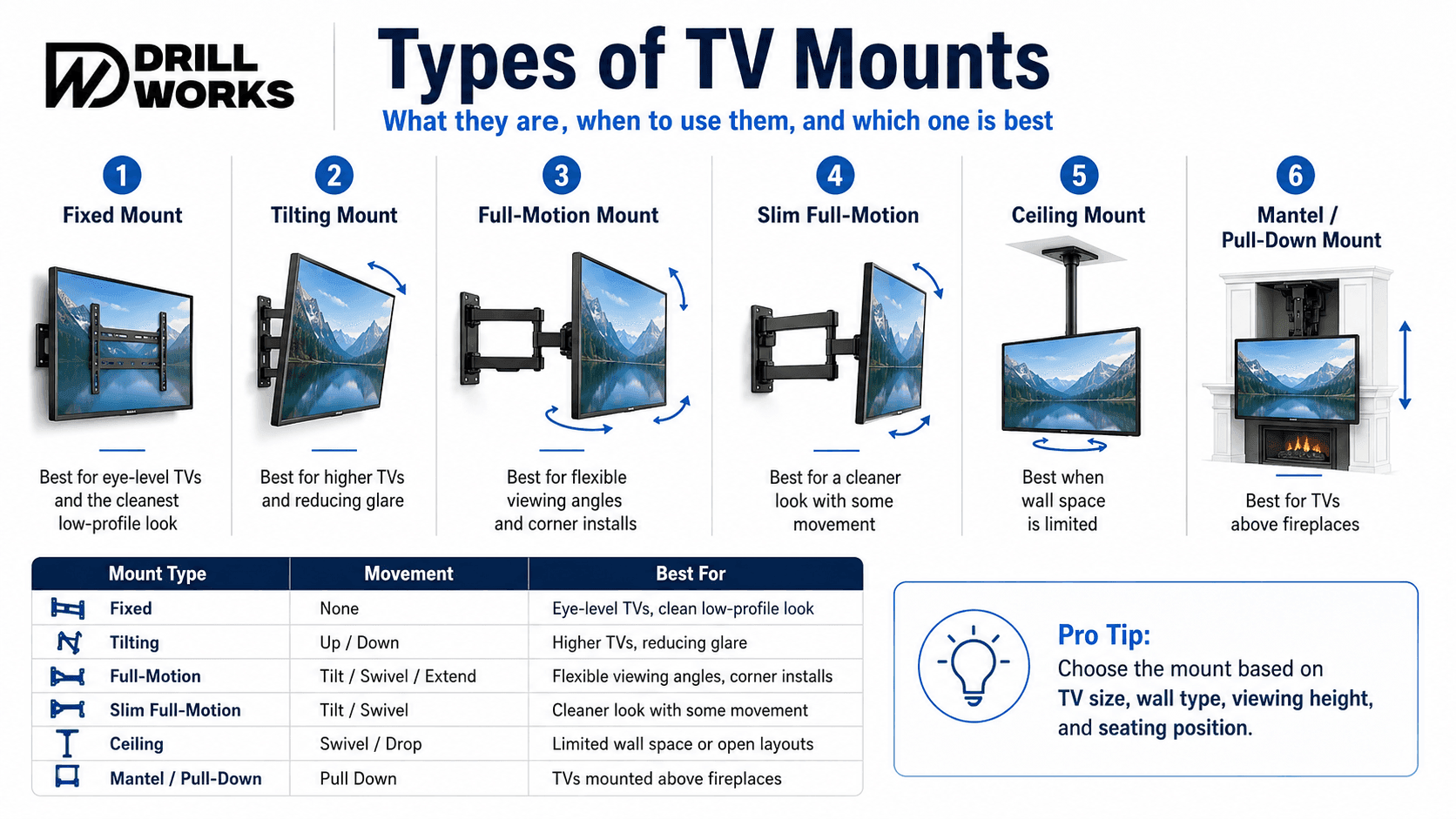
1. Fixed TV mounts
A fixed TV mount holds the TV flat against the wall with no movement. This is the simplest and cleanest type of mount. Once the TV is installed, it stays in one position.
Fixed mounts are best for living rooms with seating directly in front of the TV, bedrooms where the TV is mounted at eye level, clean minimal installations, homeowners who want the smallest gap from the wall, and large TVs that do not need to move.
The biggest advantage of a fixed mount is the low-profile look. The TV usually sits very close to the wall, which makes the setup look sleek and modern.
The downside is that you cannot tilt or swivel the TV after installation. Because of that, the height and position must be planned carefully before mounting.
2. Tilting TV mounts
A tilting TV mount allows the screen to tilt up or down. This is one of the most popular options because it gives you a clean look while adding a small amount of adjustment.
Tilting mounts are best for TVs mounted higher than eye level, bedrooms, fireplace installations, reducing glare from windows or lights, and larger TVs where minor angle adjustment is helpful.
If the TV is mounted above eye level, a tilting mount can help angle the screen downward toward the seating area. This can make watching more comfortable and reduce neck strain.
Tilting mounts usually sit slightly farther from the wall than fixed mounts, but they still maintain a clean, low-profile appearance.
3. Full-motion TV mounts
A full-motion mount, also called an articulating mount, allows the TV to tilt, swivel, and extend away from the wall. This is the most flexible type of TV mount.
Full-motion mounts are best for open floor plans, rooms with multiple seating areas, corner installations, kitchens, bedrooms, large living rooms, and situations where the TV needs to be angled.
With a full-motion mount, you can pull the TV out, turn it left or right, and adjust the viewing angle. This is very useful when the seating is not directly centered in front of the TV.
The downside is that full-motion mounts usually create a larger gap between the TV and the wall. They are also heavier and require a very secure installation, especially for larger TVs. For big screens, it is important to use a high-quality full-motion mount rated for the TV’s size and weight.
4. Slim full-motion mounts
A slim full-motion mount is designed to give you some movement while keeping the TV closer to the wall than a standard full-motion mount. This type of mount is a good compromise between a low-profile look and flexibility.
Slim full-motion mounts are best for premium TV installations, Samsung Frame-style setups, modern living rooms, clients who want movement but still care about the wall gap, and installations where appearance is a top priority.
These mounts usually do not extend as far as standard full-motion mounts, but they look cleaner when folded back against the wall. If you want the TV to sit close to the wall but still need some side-to-side adjustment, a slim full-motion mount may be the best choice.
5. Ceiling TV mounts
A ceiling mount attaches the TV to the ceiling instead of the wall. This type of mount is less common in homes but useful in specific situations.
Ceiling mounts are best for rooms with no usable wall space, commercial spaces, gyms, bars and restaurants, patios, bedrooms with unusual layouts, and open areas where wall mounting is not practical.
Some ceiling mounts allow the TV to swivel or rotate. Others can be height-adjusted. This option requires careful planning because the ceiling structure must be strong enough to support the TV safely.
6. Mantel or pull-down mounts
A mantel mount is a special type of mount often used for TVs above fireplaces. It allows the TV to be pulled down to a more comfortable viewing height.
Mantel mounts are best for TVs mounted above fireplaces, rooms where the TV would otherwise be too high, and homeowners who want better viewing comfort when the fireplace wall has enough clearance.
This type of mount can improve the viewing angle, but it is not right for every fireplace. Heat, wall structure, mantel depth, and TV size all need to be considered. Mantel mounts are usually more expensive and more complex to install than standard mounts.
Which TV mount is best?
There is no one-size-fits-all answer. The best mount depends on the room and how you watch TV.
For most standard living rooms, a tilting mount is often the best choice. It gives a clean look, allows small adjustments, and works well for TVs mounted slightly above eye level.
For the cleanest modern look, a fixed mount is usually best. For maximum flexibility, a full-motion mount is the best option. For large open spaces or corner setups, full-motion is usually the most practical choice. For TVs above fireplaces, a tilting mount or mantel mount may be the better solution.
Quick TV mount comparison
| Mount Type | Movement | Best For | Wall Gap | Main Benefit |
|---|---|---|---|---|
| Fixed Mount | No movement | Eye-level installations | Very small | Cleanest look |
| Tilting Mount | Tilts up/down | Higher mounting, glare reduction | Small | Better viewing angle |
| Full-Motion Mount | Tilts, swivels, extends | Flexible viewing | Medium to large | Maximum adjustability |
| Slim Full-Motion Mount | Tilts, swivels, limited extension | Premium clean setups | Small to medium | Flexibility with cleaner look |
| Ceiling Mount | Swivels/rotates depending on model | No wall space, commercial areas | Not applicable | Alternative mounting location |
| Mantel Mount | Pulls down/up | Above fireplace | Larger | Better height over fireplace |
Best mount by room type
Living room
Best options: tilting mount, full-motion mount, or slim full-motion mount. A tilting mount works well for most living rooms. If the room has multiple seating areas, full-motion is better.
Bedroom
Best options: tilting mount or full-motion mount. Bedrooms often need a tilt because the TV may be mounted higher for viewing from bed.
Apartment
Best options: fixed mount, tilting mount, or full-motion mount depending on wall structure. Apartments may have wall restrictions, metal studs, or rules about drilling. Always check the wall type and building rules before installation.
Above fireplace
Best options: tilting mount, mantel mount, or slim full-motion mount depending on layout. Above-fireplace installations require extra planning because height, heat, and wall structure can affect the final result.
Corner installation
Best option: full-motion mount. A full-motion mount is usually the best solution for corner setups because it allows the TV to extend and angle toward the seating area.
Cheap mount vs. high-quality mount
Not all mounts are built the same. A cheaper mount may work for a small TV, but for larger or heavier TVs, quality matters.
- Stronger metal construction
- Smoother movement
- Better extension arms
- Better tilt adjustment
- Higher weight capacity
- More secure locking features
- Better cable management
- Less sag over time
For large TVs, especially 65 inches and above, it is usually worth using a stronger, better-quality mount.
Final thoughts
The best TV mount depends on your space, your TV, and how you plan to watch it.
Choose a fixed mount if you want the cleanest look and your seating is directly in front of the TV. Choose a tilting mount if the TV is mounted higher than eye level or you want to reduce glare. Choose a full-motion mount if you need flexibility, side-angle viewing, or a corner setup.
Choose a slim full-motion mount if you want flexibility but still care about keeping the TV close to the wall. Choose a mantel mount if your TV is above a fireplace and you want a more comfortable viewing height.
The right mount makes your TV safer, more comfortable to watch, and better looking in the room. Before buying a mount, always check the TV size, weight, VESA pattern, wall type, and desired viewing angle. A properly selected and professionally installed TV mount can completely change the look and feel of your space.
Need help choosing and installing the right TV mount? A professional installation ensures your television is securely attached, perfectly leveled, and positioned for the best viewing experience possible.